
ImageProVision
Globule Size Determination in semi-solid dosage forms
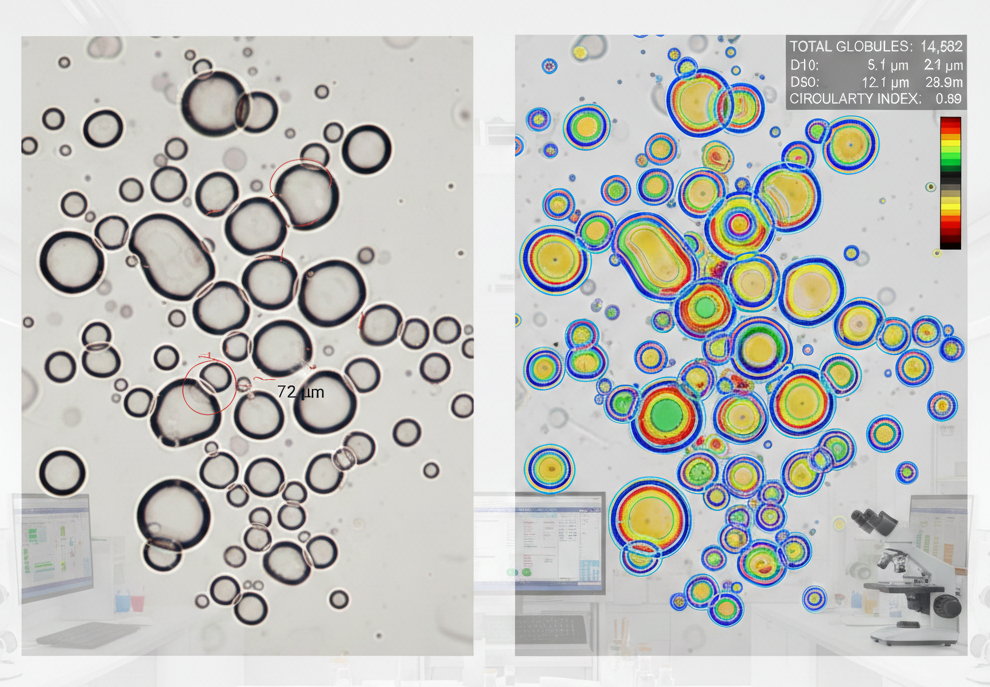
Globule size determination is a critical quality attribute (CQA) for semi-solid dosage forms like creams, ointments, and emulsions. If the oil droplets (globules) are too large or inconsistent, the drug may not be absorbed correctly through the skin, or the product may become unstable and separate.
ImageProVision automates this complex analysis through its AI-driven microscopy software, specifically designed to handle the “messy” visual nature of semi-solids.
How ImageProVision Automates Globule Analysis
- Automated Phase Separation
In a cream or emulsion, globules often overlap or “cluster” together. Standard software often miscounts these clusters as one giant globule.
- AI Edge Detection: ImageProVision uses deep learning to identify the precise boundaries (the “edges”) of each individual globule, even if they are touching.
- Feature Extraction: It distinguishes between the continuous phase (the base) and the dispersed phase (the globules) with high contrast enhancement.
- Statistical Accuracy (D10, D50, D90 )
For regulatory filings (like ANDAs for generics), you must provide a statistical profile of the globule population.
- Massive Sample Size: Instead of a lab technician manually measuring 100 globules with a reticle, the AI can scan and measure thousands of globules in seconds.
- Automatic Calculation: It immediately generates the cumulative distribution:
- D50 :The median diameter (50% of globules are smaller than this value).
- D90 :Indicates that 90% of the distribution is below this size, ensuring there are no “large” outliers that could cause grittiness.
- Handling Non-Spherical & Deformed Globules
Semi-solids are highly viscous, which can cause globules to appear non-spherical or elongated.
- Shape Factors: The software calculates “Circularity” and “Equivalent Circular Diameter.” This ensures that even if a globule is slightly squashed, its true volume is accurately represented.
Comparison: Manual vs. ImageProVision AI
Feature | Manual Microscopy | ImageProVision (ipvAutoM) |
Speed | 1–2 hours per slide | < 2 minutes per slide |
Bias | High (Human selects “easy” globules) | Zero (Analyzes every visible globule) |
Reproducibility | Low (Varies between analysts) | High (Standardized AI algorithm) |
Data Integrity | Manual logbooks (Risk of error) | Electronic records (21 CFR Part 11) |
Addressing Regulatory Requirements (FDA/EMA)
Regulators require proof that a generic semi-solid is “bioequivalent” to the brand name. ImageProVision provides the raw image data and morphological reports necessary to prove that your formulation has the same internal structure and globule distribution as the Reference Listed Drug (RLD).