
ImageProVision
Deformulation Analysis
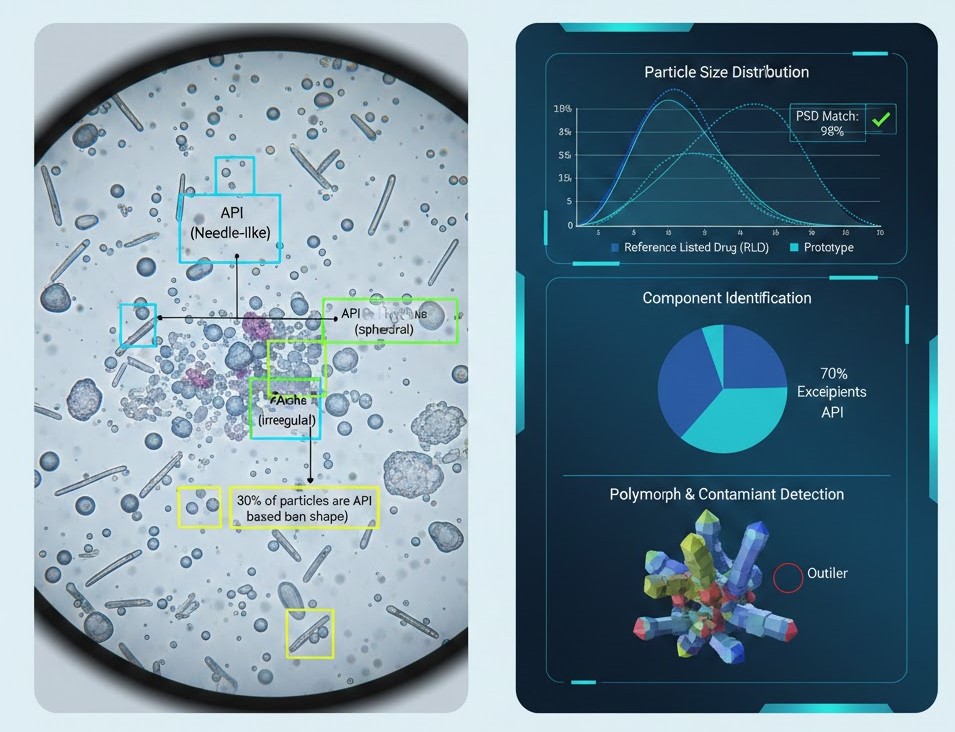
Deformulation, or Reverse Engineering, is the process of breaking down a product’s formulation to identify and quantify its components (APIs and Excipients). ImageProVision (IPV) transforms this traditionally manual, chemistry-heavy process into a faster, data-driven workflow using AI-powered microscopy and image analytics.
Here is how their technology addresses the core challenges of deformulation:
Particle Morphological Fingerprinting
The foundation of deformulation is identifying which particle is which. IPV’s software uses Morphologically Directed Analysis to categorize particles based on their physical “fingerprints.”
- The Problem: In a blended tablet, the API (Active Pharmaceutical Ingredient) and excipients are mixed. Traditional methods struggle to tell them apart visually.
- The IPV Solution: By analyzing parameters like circularity, aspect ratio, and convexity, the AI creates a library of shapes. It can then scan a sample and say, “30% of these particles are API based on their unique needle-like shape.”
Component Identification & Quantification
Through products like ipvAutoM, the system automates the counting and measurement of individual components within a complex mixture.
- Solid State Analysis: It helps determine if the API is in a specific crystalline or amorphous state, which is critical for bioequivalence.
- Volume Distribution: Beyond just counting, it calculates the volume and mass distribution of components, allowing formulators to replicate the exact “recipe” of a reference listed drug (RLD).
Particle Size Distribution (PSD) Matching
Matching the PSD of the original product is vital for ensuring the generic version dissolves at the same rate.
Feature | How ImageProVision Helps |
Agglomerate Detection | AI distinguishes between a single large particle and a “clump” of smaller ones, preventing skewed data. |
Automated Scanning | Rapidly scans thousands of particles to provide a statistically significant representation of the RLD. |
Comparison Tools | Overlays the PSD of your prototype against the RLD to identify exactly where the formulation needs adjustment. |
Polymorph & Contaminant Detection
During deformulation, you must identify different polymorphic forms of an API, as these affect stability and solubility.
- AI Classification: The software can be trained to recognize the visual texture and boundaries of specific polymorphs that are otherwise invisible to the naked eye or hard to distinguish via standard XRD (X-Ray Diffraction) alone.
- Foreign Particle Identification: It quickly spots impurities or “outlier” particles that don’t belong in the standard formulation profile.
Summary of Benefits
- Speed: Reduces deformulation timelines from weeks to days.
- Accuracy: Eliminates human bias in particle characterization.
- Regulatory Compliance: Provides the digital “proof” and high-resolution images required by regulatory bodies (like the FDA) to prove bioequivalence.