
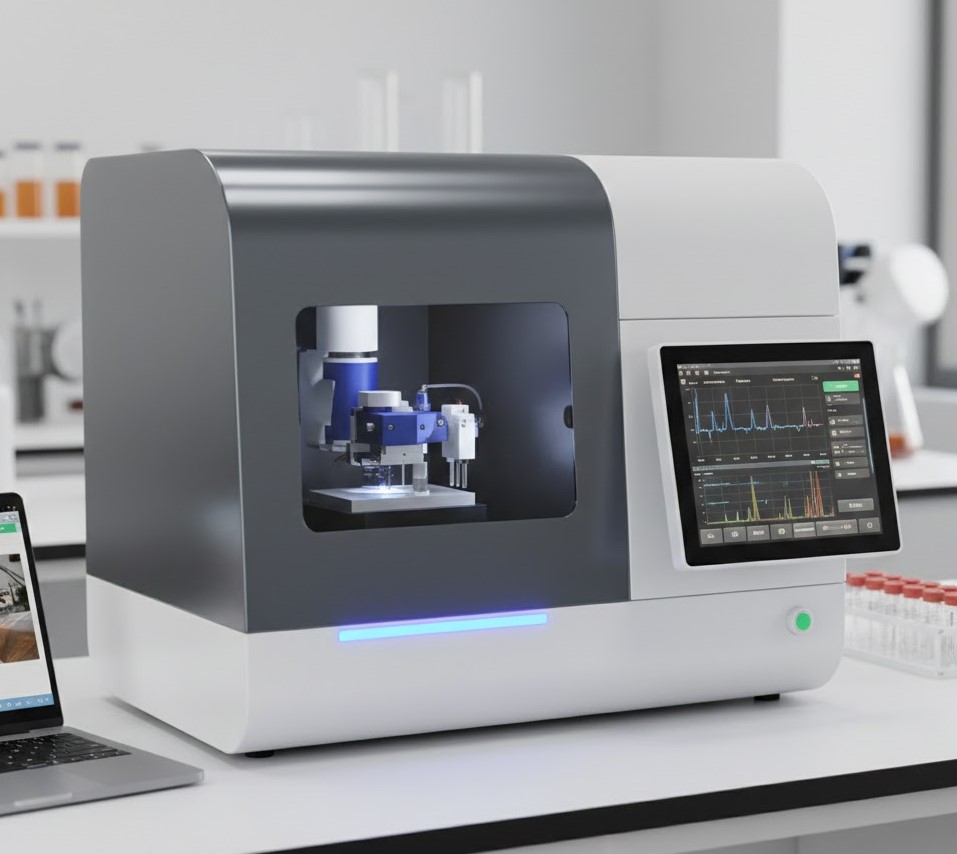
X-ray fluorescence spectrometer (XRF)
The X-ray Fluorescence (XRF) Spectrometer is a premier analytical instrument for rapid, non-destructive elemental analysis. It allows for the precise determination of the chemical composition of a wide variety of materials, including solids, powders, liquids, and thin films, with minimal to no sample preparation.
Key Analytical Capabilities
Our XRF systems utilize Energy Dispersive X-ray Fluorescence (EDXRF) technology, offering a versatile solution for both qualitative screening and high-precision quantitative analysis.
- Broad Elemental Range: Capable of detecting elements from Sodium (Na) to Uranium (U). Specialized configurations can extend this range down to Fluorine (F) or even Carbon (C) for light element analysis.
- Non-Destructive Testing: The analysis does not consume or damage the sample. This is critical for high-value items such as gemstones, historical artifacts, and forensic evidence.
- Trace Element Detection: Features high-sensitivity detectors that can identify trace concentrations at the parts-per-million (ppm) level, essential for identifying impurities and geographic origins.
- Multi-Element Analysis: Simultaneously detects and quantifies multiple elements in a single measurement cycle, typically within 30 to 300 seconds.
Technical Features & Design
- Advanced X-Ray Tube: Equipped with a high-stability X-ray tube (typically with a Rhodium or Silver anode) and adjustable voltage settings (up to 50 kV) to optimize excitation for different element groups.
- High-Resolution Detection: Features a state-of-the-art Silicon Drift Detector (SDD). This liquid nitrogen-free detector provides excellent energy resolution and high count rates, ensuring precision even for complex matrices.
- Large Sample Chamber: The spacious analytical chamber is designed to accommodate samples of various shapes and sizes. Optional automatic sample changers are available for high-throughput laboratory environments.
- Integrated Imaging: A high-resolution built-in camera allows for precise sample positioning and “small-spot” analysis on specific areas of interest (down to 0.5 mm).
- Vacuum & Helium Purge Options: Supports measurement in air, vacuum, or Helium-purged environments to enhance the sensitivity for light elements (like Al, Si, P, and S).
Technical Specifications
Parameter | Specification |
Principle | Energy Dispersive X-ray Fluorescence (EDXRF) |
Detectable Range | Na (11) to U (92) [Optional: F (9) to Am (95)] |
X-Ray Source | 50 W / 50 kV (Max) with Rh or Ag Anode |
Detector Type | Silicon Drift Detector (SDD), Peltier Cooled |
Energy Resolution | < 135 eV (at Mn K alpha) |
Sample Atmosphere | Air, Vacuum, or Helium Purge |
Interface | High-speed USB / Ethernet with dedicated PC software |
Primary Applications
- Gemology & Jewelry: Accurate determination of gold and silver fineness; identification of trace elements to distinguish natural from synthetic stones and detect treatments (e.g., lead-glass filling in rubies).
- Metallurgy: Quality control for alloy composition and identification of tramp elements in scrap metal recycling.
- Environmental Monitoring: Detection of heavy metals (Pb, As, Hg, Cd) in soil, water, and air particulates.
- Petrochemicals: Monitoring sulfur and chlorine content in fuels and lubricants in compliance with ASTM and ISO standards.
- Pharmaceuticals: Screening for elemental impurities in active pharmaceutical ingredients (APIs) and excipients.