
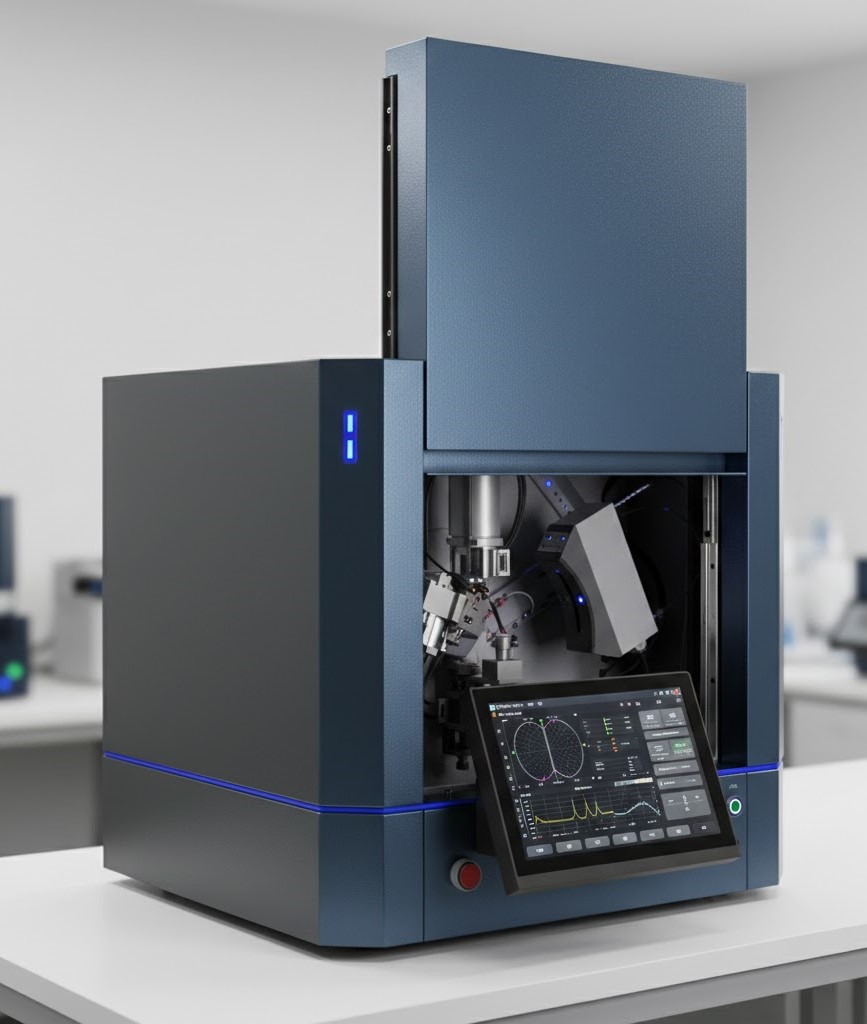
X-Ray Diffractometer (XRD)
The X-Ray Diffractometer (XRD) is a critical instrument for the non-destructive analysis of crystalline materials. By utilizing the principle of X-ray diffraction, it allows for precise identification of phase composition, crystal structure, and physical properties in materials ranging from powders and solids to thin films and liquids.
Core Technology & Design
Our XRD systems are built around a high-precision Vertical $\theta$-$\theta$ Goniometer. This design keeps the sample in a horizontal position at all times, making it ideal for the analysis of large, heavy, or liquid samples that would otherwise shift in a traditional $\theta$-2$\theta$ setup.
- Advanced Goniometer Precision: Features an independent dual-axis drive with a minimum step size of 0.0001°, ensuring the highest level of angular reproducibility and data reliability.
- High-Output X-Ray Generation: Equipped with a highly stable generator (up to 3 kW) that supports multiple tube types, including fine-focus and broad-focus anodes (Cu, Co, Cr, or Mo), providing the flexibility needed for different material densities.
- Optical Versatility: The system can be switched between standard Bragg-Brentano focusing optics for routine powder analysis and Parallel Beam optics (via a polycapillary unit) for irregular surfaces, thin films, and curved samples.
Key Capabilities
- Qualitative & Quantitative Phase Analysis: Rapidly identify unknown substances by comparing diffraction patterns against the ICDD database and perform precise quantification of multi-phase mixtures.
- Crystallographic Characterization: Determine lattice constants, degree of crystallinity, crystallite size, and internal crystal strain with high accuracy.
- Thin Film Analysis: Specialized grazing incidence (GIXRD) and reflectometry (XRR) modes allow for the measurement of layer thickness, density, and interface roughness in multilayered structures.
- Environmental & Industrial Safety: Includes analysis packages for the detection of free silicic acids and asbestos in construction materials, and residual austenite quantification in metallurgy.
Technical Specifications
Parameter | Specification |
Goniometer Geometry | Vertical theta (Sample remains horizontal) |
Minimum Step Size | 0.0001° |
Angular Range (2 theta) | -6° to +132° (depending on configuration) |
X-Ray Generator Power | 2.2 kW to 3.0 kW (High-stability) |
Standard Detector | High-speed scintillation or wide-range 1D/2D detector |
Sample Size Capacity | Up to 400 mm (W) x 550 mm (D) x 400 mm (H) |
Slew Speed | Up to 1000°/min |
Safety and Software Integration
- Radiation Protection: The instrument is housed in a fully lead-shielded enclosure with a fail-safe magnetic interlock system. X-ray generation is automatically disabled if the door is opened.
- User-Friendly Control: Operated via a standard PC interface with integrated software for instrument control, peak search, Rietveld refinement, and automated data processing.
- Automation Options: Supports automatic sample changers and environmental chambers for non-ambient studies (heating/cooling